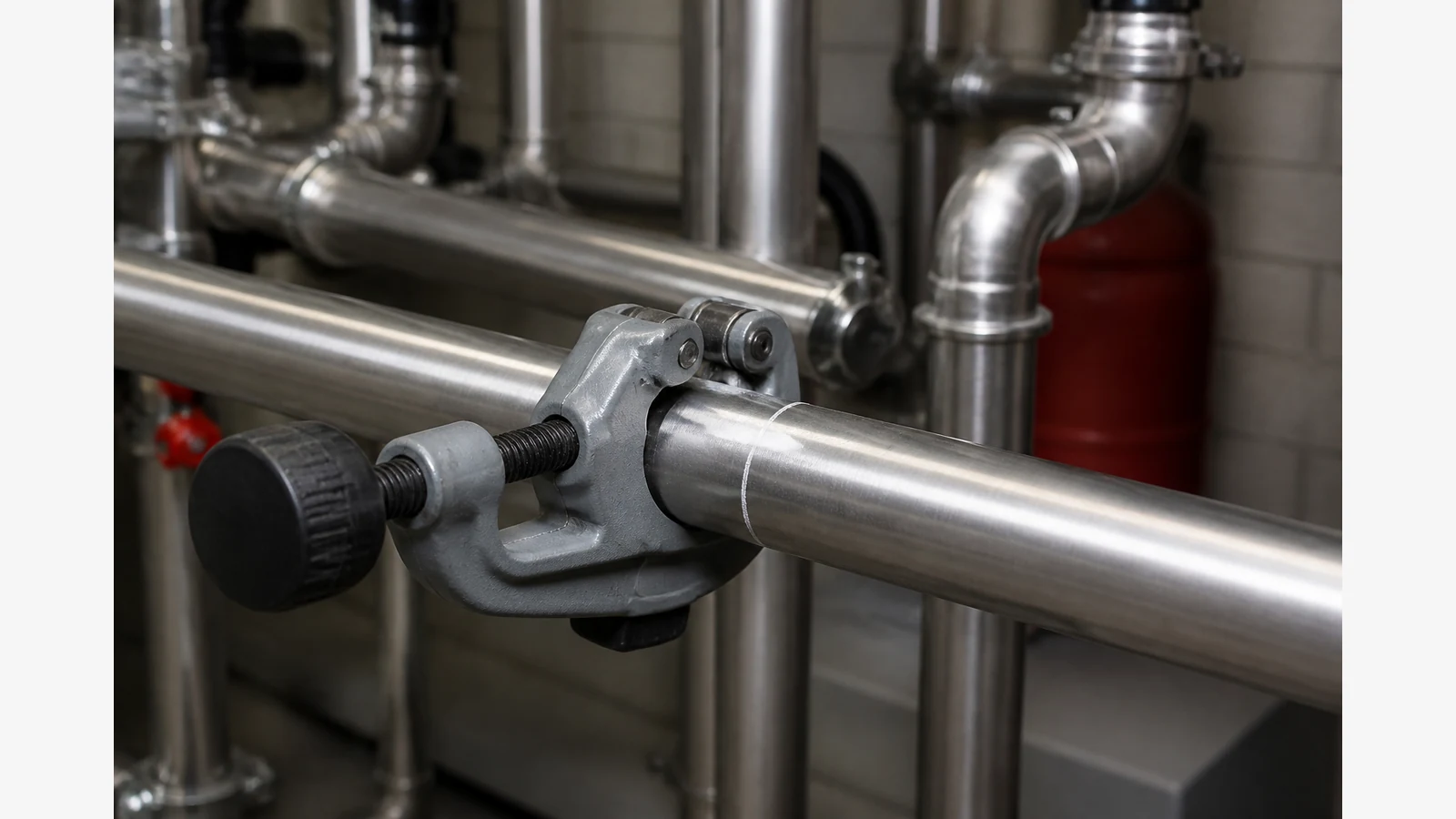
Stainless steel tube cutter UK: match capacity, wheel and access before you buy
For UK trade stainless work, choose a cutter that is explicitly rated for stainless (not a copper-only domestic cutter), with an OD capacity that covers the sizes you cut most weeks, and a replaceable hardened stainless wheel. Capacity on paper is useless if the frame will not rotate in the cupboard or riser where you actually cut.
What UK installers actually cut
Domestic heating and plumbing vans usually live on 15 mm, 22 mm and 28 mm tube, with occasional larger stainless runs in plant rooms and commercial jobs. That mix means you should shortlist on the largest OD you cut weekly, then check stainless rating and spare-wheel support — not marketing “max capacity” alone.
Access under boilers and in risers often matters as much as capacity. A wide-frame rotary cutter that looks impressive on a bench can be the wrong tool in a tight cupboard; for very tight installed stainless, category tools such as powered installed-pipe cutters exist with published low-clearance claims (for example, Milwaukee’s M12 RAPTOR stainless cutter guidance).
Decision path: capacity, wall, material, clearance, wheels
| Check | Why it matters | What to verify |
|---|---|---|
| OD range | Covers weekly sizes with headroom | Published capacity for your largest common OD |
| Wall-thickness limit | Limits vary by model | Maker’s current limit — do not guess from another tool |
| Material rating | Copper wheels fail quickly on stainless | Stainless-rated / hardened wheel and rollers |
| Clearance / rotation | Cupboards and risers kill wide frames | Measure space before packing the van |
| Wheel availability | Dull wheels drive rework on press ends | Spare stainless wheel in kit or stock |
Public manufacturer examples illustrate the category: RIDGID’s stainless tubing cutters publish separate compact and wide OD ranges (for example 35S versus 65S capacity bands) and a bearing-wheel design on their stainless steel tubing cutters page. UK trade listings such as the REMS RAS Cu-INOX 6–64 mm cutter show how stainless/copper capacity is marketed for confined site work. Treat those figures as examples of how makers publish capacity — not as claims about any single shop SKU.
Who should not buy a wide-capacity rotary cutter
- One-off soft-copper DIY cuts where a mini copper cutter is enough.
- Installed cuts with almost no rotation clearance, where a powered installed-pipe cutter is the designed category.
- Anyone hoping one oversized frame will replace measuring clearance and packing a spare stainless wheel.
Next step
Measure the largest OD you cut in a typical week, then shortlist stainless-rated tools whose published capacity covers it and that have spare-wheel support. If you also need to decide whether wide OD capacity is worth the heavier frame, see our large pipe cutter capacity checklist. For material mismatches, read copper vs stainless tube cutter. When a capacity-matched stainless trade cutter is the next step, review the site detail for a stainless-rated rotary option: stainless steel tube cutter product detail.